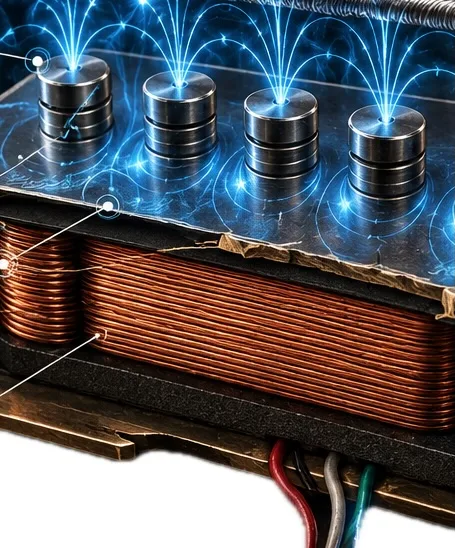
Quick answer. Pickup inductance is a measurement, in Henries (H), of how a guitar pickup’s coil stores magnetic energy. It is one of the best indicators of a passive pickup’s tonal character because it strongly influences resonant frequency, perceived output and frequency response. Lower inductance generally produces brighter, clearer tones, while higher inductance usually produces thicker, warmer, more powerful sounds.

What Is Pickup Inductance?
If you’ve ever compared guitar pickups, you’ve probably noticed that manufacturers proudly advertise DC resistance in kilo-ohms (kΩ). While that measurement is useful, it only tells part of the story.
Pickup inductance is often a much better indicator of how a passive magnetic guitar pickup will actually sound.
Measured in Henries (H), inductance describes how strongly a pickup’s coil stores magnetic energy as an electrical signal is generated. In simple terms, it influences how the pickup responds across the guitar’s frequency range and where its natural resonant peak sits.
Think of it like this:
- DC resistance tells you how much wire is in the pickup.
- Inductance tells you how that pickup is likely to behave.
For players looking for more accurate specifications than marketing terms like warm, vintage or high output, inductance is one of the most useful measurements available.
The Simple Explanation
Imagine two loudspeakers.
One produces crystal-clear speech.
The other produces deep, powerful bass.
Both might use the same amplifier, but their design changes which frequencies they naturally emphasise.
A guitar pickup works in a similar way.
The inductance of the pickup influences which frequencies are naturally emphasised and which begin to roll away.
Generally speaking:
- Lower inductance usually sounds brighter and more open.
- Higher inductance usually sounds thicker, fuller and more powerful.
That doesn’t mean one is better than the other.
It simply means they’re designed for different musical jobs.
Why Is Inductance More Useful Than DC Resistance?
For decades guitarists have compared pickups using DC resistance.
Unfortunately, this has led to one of the biggest myths in the guitar world.
A higher resistance pickup is not automatically a higher output pickup.
Resistance simply measures the length and thickness of the copper wire wound around the bobbin.
Inductance takes into account how the complete magnetic circuit behaves.
Two pickups can both measure 8.0 kΩ yet sound completely different because they have:
- different magnets
- different core materials
- different coil geometry
- different winding patterns
- different inductance
This is why experienced pickup designers, like Warman, often pay much closer attention to inductance than resistance when evaluating a new design.
What Does Inductance Do To Tone?
As inductance increases, the pickup’s resonant frequency generally moves lower.
In practical terms this usually means:
Lower Inductance (around 2–3H)
Typically produces:
- brighter highs
- tighter bass
- greater note separation
- more sparkle
- cleaner clean sounds
Ideal for:
- country – example Warman Tele Vintage 5/2 neck pickup
- funk – a good pickup for funk are the Wavetrains
- classic Strat tones
- vintage Telecaster sounds
Medium Inductance (around 3–5H)
Often provides:
- balanced frequency response
- punch
- warmth without muddiness
- excellent versatility
Ideal for:
- blues – a popular choice for blues single coil pickups are the Texas Triple Hots
- classic rock – Blues Babies are great choice here
- indie – Soapy Joes are a go to choice for punchy Indie tones
- pop
- session work
Higher Inductance (5H and above)
Usually gives:
- stronger midrange
- thicker bass
- smoother treble
- greater perceived output
- powerful overdriven sounds
Perfect for:
- hard rock –Destroyers are the all rounder for hard rock tones.
- metal – Classic metal tone can be had with the Zebra
- modern rock – our number one choice here are the Stealths
- high-gain amplifiers
Remember that these are general trends rather than hard rules. Magnet material, pickup construction, cable capacitance and the rest of the guitar’s electronics all contribute to the final result. A pickup’s resonant behaviour comes from the interaction of its inductance with its capacitance and load, not inductance in isolation.
Does Higher Inductance Mean Higher Output?
Usually…
…but not always.
Higher inductance often accompanies more turns of wire, which can increase signal voltage.
However, output is also affected by:
- magnet strength
- pole piece material
- string height
- pickup height
- coil efficiency
- magnetic field shape
This is why two pickups with almost identical resistance can produce noticeably different output levels.
Why Warman Guitars Lists Inductance
At Warman Guitars we believe guitarists deserve better information than simply quoting DC resistance.
Whenever practical, we publish both DC resistance and inductance because together they provide a far more complete picture of a pickup’s design.
For example:
A bridge pickup measuring:
- 16 kΩ
- 7.1 Henries
immediately tells an experienced builder that it is designed as a high-output pickup with a strong midrange voice.
Meanwhile another pickup measuring:
- 7 kΩ
- 2.4 Henries
suggests a brighter, lower-output design with greater top-end detail.
These numbers don’t tell the whole story—but they are far more informative than resistance alone.
Can Two Pickups Have The Same Resistance But Sound Completely Different?
Absolutely.
This happens surprisingly often.
Imagine two pickups that both measure:
8.0 kΩ
One may measure:
2.8 Henries
The other:
4.8 Henries
Although the resistance is identical, the second pickup will usually sound thicker and fuller, while the first may sound brighter and more articulate.
This is one reason why relying on resistance figures alone can be misleading.
What Is A Good Pickup Inductance?
There isn’t a single “best” inductance.
It depends entirely on the sound you’re trying to achieve.
Bright vintage tones
Approximately 2–3H
Classic rock
Approximately 3–5H
High output rock and metal
Typically 5H and above
Remember that inductance is one part of the overall design. Magnet choice, winding pattern, pickup height and even your guitar cable all influence the final tone.
Frequently Asked Questions
Is inductance more important than DC resistance?
For predicting how a passive pickup is likely to sound, inductance is generally more informative than DC resistance, although neither specification tells the whole story.
Why don’t more pickup companies publish inductance?
Many manufacturers continue using DC resistance because it is quick and inexpensive to measure with a standard multimeter. Measuring inductance accurately normally requires dedicated LCR test equipment and consistent test conditions.
Does higher inductance always mean darker tone?
Not always. It generally shifts the tonal balance towards a fuller sound, but magnet type, winding geometry, covers, cable capacitance and the guitar’s electronics also affect the final result.
Is inductance the same as output?
No.
Higher inductance often accompanies higher output, but output also depends on the magnetic circuit and overall pickup design.
Should I compare pickups using Henries?
Yes.
If manufacturers publish inductance measured under consistent conditions, it is one of the most useful specifications available when comparing passive magnetic pickups.
Final Thoughts
If you’ve only ever compared pickups by looking at DC resistance, you’ve only been seeing part of the picture.
Inductance provides a much better insight into how a passive pickup is likely to behave before you ever plug your guitar into an amplifier.
It helps explain why two pickups with identical resistance can sound completely different, why some pickups sparkle while others roar, and why great pickup design is about balancing the entire magnetic and electrical system rather than chasing a single specification.
At Warman Guitars we believe in publishing meaningful technical information alongside real-world descriptions, helping guitarists choose pickups based on engineering as well as experience.
About the Author
Josi Warman is the founder of Warman Guitars and has over 40 years of hands-on experience building, repairing, modifying and wiring electric guitars. He has designed and supplied guitar pickups and guitar parts to thousands of players worldwide through Warman Guitars. As well as developing pickup designs and custom wiring solutions, Josi regularly publishes practical guitar wiring guides and technical articles to help players understand how pickups, electronics and guitar components affect tone and performance.
Why Trust Warman Guitars?
Warman Guitars has spent over 4 decades designing, testing and supplying guitar pickups for musicians across the UK and around the world. Rather than relying on marketing buzzwords, we focus on measurable specifications, practical experience and straightforward advice that helps players choose the right pickup for their sound.