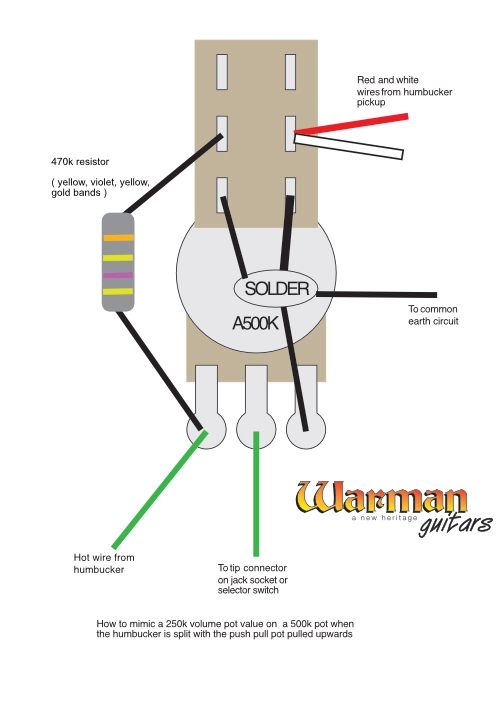
How to Change the Value of a Pot When Coil Splitting a Humbucker
So, you’ve got yourself a nice chunky humbucker. It’s fat, warm, and sings like Pavarotti after three espressos. But sometimes—just sometimes—you want that bright, snappy, single-coil zing without swapping guitars mid-song or attempting dangerous gymnastics with your pickup selector. Enter the world of coil splitting (or coil tapping, though let’s be clear: those aren’t exactly the same thing, but we’ll forgive the mix-up at parties).
Now, here’s where things get juicy. You can coil split your humbucker, but what you might not know is that the value of your volume potentiometer (that trusty 500k pot) can massively influence how convincing—or underwhelming—that single coil sound actually is. Today we’re diving into a neat little wiring trick: using a resistor in parallel with the pot when the coil split is engaged, effectively changing the pot’s resistance. It sounds wizardly, but really it’s just clever math and solder.
Grab a cuppa, because we’re about to demystify it.
Humbuckers, Single Coils, and Pot Values – The Quick Refresher
Before we get to the resistor sorcery, let’s remind ourselves what’s going on.
- Humbuckers are usually paired with 500k pots. Why? Because they’re big, warm, and powerful, and a higher-value pot keeps them from sounding like they’re under a duvet. A 500k pot lets more of the pickup’s natural brightness through.
- Single coils (Strat, Tele, that jangly sound you love) are more commonly wired with 250k pots. This slightly lower resistance rolls off a bit of high-end zing, taming the ice-pick treble and smoothing the tone into something more musical.
So, when you coil split a humbucker into a single coil but leave it running through a 500k pot, guess what? It can sound a bit shrill. Like a seagull stealing your chips. Not quite the sweet single coil you were dreaming of.
That’s where the resistor trick comes in.
The Clever Wiring Trick: A 470k Resistor in Parallel
Here’s the setup:
- You’ve got a 500k volume pot as normal.
- You add a 470k resistor, but only bring it into play when you pull up the coil-split switch (on a push-pull pot, for instance).
What does this do? Simple: the resistor is wired in parallel with the pot. When you engage the coil split, the resistor joins the party and lowers the effective load the pickup sees.
The math for two resistors in parallel looks like this:Rtotal=1(1R1+1R2)Rtotal=(R11+R21)1
So with a 500k pot and a 470k resistor in parallel:Rtotal=1(1500,000+1470,000)Rtotal=(500,0001+470,0001)1
If you don’t fancy dusting off your calculator, the result is roughly 242k.
See what’s happened? Your 500k pot has magically turned into a ~250k pot only when the coil split is engaged.
That’s right—when you pull that knob, you’re not just splitting the humbucker, you’re also re-voicing the entire guitar circuit to behave more like a single coil setup. Two birds, one soldering iron.
What’s Actually Happening to the Tone
Let’s break it down in ear-friendly terms:
- Humbucker mode (no resistor engaged): The pickup sees the full 500k pot. This keeps the humbucker clear and bright, letting those glorious mids and lows sing without chopping off too much treble. Fat, warm, balanced. Perfect for those creamy solos and crunchy riffs.
- Coil split mode (resistor engaged): The pot + resistor combo now looks like ~250k to the pickup. This loads the single coil down more, just like on a Strat or Tele. The result? The brightness is tamed, the shrill edge is smoothed out, and you get a more authentic single coil tone instead of “half a humbucker pretending badly.”
In other words, without the resistor, a coil-split humbucker can sound like it’s got too much top-end—thin and brittle. With the resistor, it suddenly “sits” in the mix properly, sounding fuller, smoother, and much closer to what you’d expect from a genuine single coil guitar.
Why Not Just Use a 250k Pot All the Time?
Good question. If 250k is better for single coils, why not just install that and call it a day?
Because your poor humbucker would weep. With only 250k all the time, the humbucker loses too much top end. It becomes muddy and muffled, like it’s being played through a pillow.
The beauty of the resistor trick is that you get the best of both worlds. Humbucker sees 500k. Single coil sees ~250k. Everyone’s happy.
Think of it like a guitar equivalent of wearing bifocals—one lens for reading, one for distance. Except instead of making you look like your granddad, it makes your guitar sound brilliant in two completely different voices.
The Practical Wiring
So how do you wire it? Thankfully, it’s not brain surgery. Here’s the gist:
- Use a push-pull pot for your volume control. This will do two jobs: split the coil and switch the resistor.
- Wire your coil split as normal (short one coil of the humbucker to ground via the switch).
- Add a 470k resistor from hot to ground on the switching side of the push-pull. Only connect it so it comes into circuit when the pot is pulled up (coil split engaged).
That’s it. When down: normal humbucker with a 500k load. When up: coil split plus resistor engaged, load drops to ~250k. Clever, clean, and effective.

The Result in Real Life
Guitarists who try this trick are usually a bit gobsmacked. Instead of the coil split sounding like a weak impersonation of a single coil, it suddenly feels much more authentic.
- Strat-like spank on the bridge.
- Tele twang on the neck.
- A usable, versatile guitar that can go from Les Paul growl to Fender snap without swapping instruments mid-gig.
It’s not exactly the same as a true single coil, of course. Physics and pickup construction still matter. But it’s close enough that in a band mix, most listeners will never know you’re not swapping guitars like The Edge with a roadie army.
Wrapping It Up
So, to recap in simple terms:
- Humbuckers love 500k pots.
- Single coils love 250k pots.
- Coil-splitting a humbucker without adjusting pot value can sound shrill.
- Add a 470k resistor in parallel with a 500k pot when coil split, and poof! you get an effective 250k load only in split mode.
- Result: fat humbucker tones when you want them, convincing single coil tones when you don’t.
It’s like fitting your guitar with a personality switch: smooth lounge singer one minute, bright chatterbox the next. All thanks to a humble resistor and a bit of clever wiring.
If you’ve ever felt disappointed by coil splits, this little trick might just be the secret ingredient you’ve been missing. And best of all—it only costs pennies and about half an hour with a soldering iron.
Go on, give your guitar the best of both worlds. Your ears (and probably your bandmates) will thank you.
This article was written by Josi Warman, founder of Warman Guitars. With over 40 years of experience building guitars, designing pickups, creating custom wiring systems and publishing guitar-building guides, Josi has helped thousands of players upgrade and customise their instruments.